
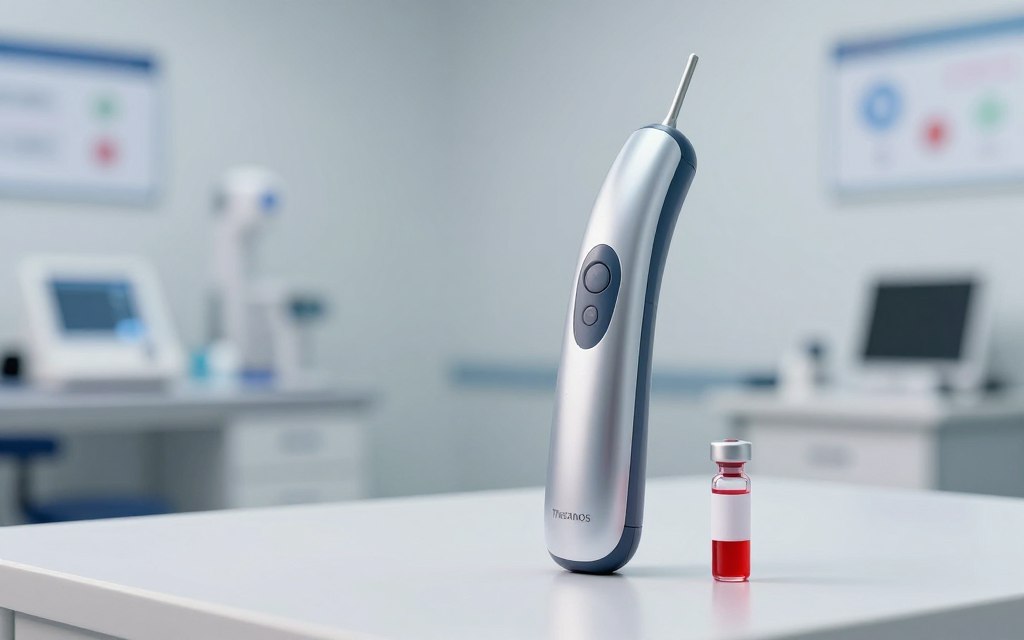
Theranos promised dozens of blood tests from a finger prick, but its testing practices later came under intense scrutiny. Finger-stick blood collection means taking a blood sample by puncturing the skin at the fingertip.
Investigations found that the company used conventional lab analyzers for most tests, while some results from its Edison devices proved unreliable. Theranos closed in 2018, leaving a sharp gap between its public claims and its actual work.
This account separates the advertised promise from what the devices did, and explains the lasting effects on patients, workers, and investors. The story begins with how Elizabeth Holmes built the company and attracted early backing.
Key Takeaways
- Theranos claimed a few drops could support a wide range of tests.
- Most testing relied on conventional lab machines, not Edison devices.
- Questions about accuracy led to regulatory action and legal cases.
- The company closed in 2018, and its shares became worthless.
- Small-sample testing can work for specific tests when properly validated.
How Did Elizabeth Holmes Build Theranos?
At 19, Elizabeth Holmes left Stanford University to pursue a startup focused on blood testing. That choice began a rise that would make Theranos one of Silicon Valley’s best-known companies.
Holmes founded Theranos in 2003. The company name blended “therapy” and “diagnosis,” reflecting its goal of linking lab testing with health care.
A famous name on a board or investor list cannot prove that a medical technology works.
From a Stanford idea to a startup
Holmes left school before finishing her degree and set out to change how people got blood tests. The company aimed to make testing cheaper and easier to reach.
That pitch appealed to people frustrated by conventional blood draws, delays, and costs. A startup promising simpler access to health information had a clear story for patients and investors.
Related Posts:
- Is Metamorph Technologies a Division of Metamorph…

- What is a Tech Hacker Skills and Tools Explained

- Exploring the Ethical Issues of Biometric Technology
- New Tech During the Hundred Years War: What Developed

- Is Technology a Good Career Path: Pros and Cons

- What Helped Western European Nations Develop Better…

The investors and valuation behind the rise
Theranos raised more than $700 million from venture capitalists and private investors. Its valuation reached $9 billion in 2013 and 2014.
Prominent early investors included Rupert Murdoch, Betsy DeVos, and Henry Kissinger. Their names helped the company seem credible, though prominent backing is not evidence of sound testing.
Investors also saw a possible market for low-cost lab work across the country. The company’s public profile grew as Holmes appeared at events and described a future of easier testing.
Those years of growth rested on a promise consumers could understand: fewer drops, fewer hurdles, and more information. The next question was what customers were told the blood tests could do.
What Did Theranos Promise Its Blood Tests Could Do?
A patient seeking several lab results might prefer a quick finger prick to a standard blood draw. Theranos said its tests could offer that simpler route using only a few drops of blood.
The company claimed the technology could detect a wide range of health issues and cost about half as much as conventional testing. Those claims described an intended benefit, not proven clinical performance.
Theranos presented the idea as a way to make testing faster and more convenient. People might visit a nearby retail location, give a small sample, and receive results without a traditional draw.
- Tiny sample: a few drops rather than a standard draw.
- Many tests: a broad menu from one testing system.
- Lower cost: about half the price of conventional testing.
- Convenient access: blood testing through easier, consumer-facing services.
That list captured the sales pitch, not a record of reliable results. A company can describe what a device should do, but testing must show whether it does so in real use.
Customers and clinicians needed results they could trust, especially when decisions depended on them. That made the central question whether Theranos’s proprietary devices could deliver the promised range accurately.
What Happened to Theranos Technology?
Theranos advertised portable proprietary analyzers, but conventional machines ran most of its tests. The gap between the claim and lab practice was central to what happened to Theranos technology.
The evidence did not establish a working, scalable system for the broad test menu Theranos promised. The SEC alleged that the proprietary analyzer could perform only 12 of the 200 tests on the company’s published menu.
What the Edison devices and nanotainer were meant to do
Theranos said its Edison devices could run many blood tests from finger-prick samples. The company’s nanotainer, a small blood-collection container, was meant to gather and transport those samples.
The approach aimed to replace larger draws with a small amount of blood and portable lab equipment. In theory, the patient could give a sample at a convenient site, and the device would run the tests.
Why the company relied on conventional lab analyzers
Reporting later revealed that Theranos used conventional blood-testing machines for most of its tests. Its proprietary method covered only a small part of the advertised menu.
This meant the broad promise did not match the company’s actual testing practices. Some conventional analyzers also needed more blood than a finger-stick sample could provide.
What the disclosed testing practices meant for the promise
The comparison shows where the claims and practice differed:
| Aspect | Theranos’s promise | What was disclosed |
|---|---|---|
| Sample | A few finger-prick drops | Most testing used conventional blood draws |
| Analyzer | Proprietary portable devices | Conventional machines ran most tests |
| Test menu | A broad published menu | The SEC alleged the proprietary analyzer could perform 12 of 200 tests |
Having a device that runs some tests does not prove it can run a much larger menu. Each test needs evidence that the method works as intended.
The technology gap mattered because clinicians use test results to guide care. That leads to the patient risk created by unreliable results.
Why Were Theranos’s Blood-Test Results a Problem?
An incorrect blood result can lead a patient or clinician to repeat a test, delay care, or consider the wrong next step. Accuracy matters because medical choices often depend on lab results.
In 2016, Theranos voided two years of results from its Edison devices and corrected tens of thousands of blood-test reports. Those actions showed that many past reports needed review or correction.
A result outside the expected range might prompt more tests or a change in treatment. A result that appears normal could also offer false reassurance when further care is needed.
Voiding a report means it should no longer guide medical decisions as a valid result. Correcting reports tells patients and clinicians that earlier information may have changed.
Still, a flawed result is not the same as a confirmed diagnosis or proven injury. The record does not mean every Theranos result was wrong, or that every patient suffered harm.
The uncertainty itself mattered. Patients needed clear information about whether a result could be trusted and whether repeat testing was needed.
As questions about the results grew, outsiders began to examine how the company worked and whether its claims matched its lab practices.
How Did the Wall Street Journal and Whistleblowers Expose the Problems?
Theranos projected confidence in public while some employees raised concerns about its testing. That tension became harder to ignore as scientific questions and reporting challenged management’s account.
In February 2015, Stanford professor John Ioannidis questioned the lack of peer-reviewed research on Theranos. In October, Wall Street Journal reporter John Carreyrou reported that conventional machines ran most tests and questioned Edison accuracy.
Scientific questions preceded the major investigation
Peer-reviewed research lets other experts assess how a test performs. The lack of published evidence left outside researchers with little data to judge the company’s claims.
The Wall Street Journal report on Tyler Shultz described a former employee’s concerns and the personal costs of speaking out.
Employees and journalists challenged the company’s account
Former employee Tyler Shultz became a key source for Carreyrou’s investigation. He had raised concerns within the company, including questions about research and quality control.
Holmes publicly denied the allegations, and Theranos pushed back strongly against the reporting. This response became part of a leadership crisis, as management faced a growing challenge to its public claims.
Four warning signs stood out:
- Little peer-reviewed research supported the public claims.
- Secrecy made the methods hard for outsiders to assess.
- Employee concerns did not receive a clear answer.
- Public claims did not match the lab’s reported practices.
These signs do not prove a person’s private motive. They show why employees need safe ways to raise concerns, and why management must address them.
Journalism brought the issue to wider attention, while regulators had legal authority to inspect labs and act on patient-safety concerns.
What Did Regulators Find and Do?
FDA clearance for one test did not validate Theranos’s full diagnostic menu. That limit matters when a company makes claims about many blood tests.
The FDA oversees medical devices, CMS oversees clinical labs, and the SEC enforces securities laws. Each agency addressed a different part of Theranos’s conduct.

In July 2015, the FDA cleared Theranos’s finger-stick collection device for the herpes simplex 1 test. It was the company’s only FDA-cleared diagnostic test.
| Agency | Focus or finding | Action or significance |
|---|---|---|
| FDA | Nanotainer treated as an uncleared device | Only the herpes simplex 1 test was cleared |
| CMS | Newark lab put patients in immediate jeopardy | CLIA certificate revoked and two-year exit from blood testing |
| SEC | Alleged false or exaggerated claims about technology, business, and finances | Civil fraud charges filed in 2018 |
The FDA identified the nanotainer as an uncleared medical device. That finding did not mean every Theranos test had FDA clearance.
In January 2016, the Centers for Medicare and Medicaid Services (CMS) said the Newark, California, lab created immediate jeopardy to patient health and safety. CMS revoked the lab’s CLIA certificate in July.
In 2017, Theranos agreed to stay out of the blood-testing business for two years. The Securities and Exchange Commission (SEC) filed civil fraud charges against Holmes and Balwani in March 2018.
Regulatory pressure narrowed the company’s options. Its retail partnerships had already brought the testing claims into public view.
How Did Theranos’s Partnerships Expand Its Reach?
The first Walgreens Wellness Center in Palo Alto turned Theranos’s promise into a retail service. For customers, the partnership offered a place to access blood tests outside a traditional lab.
Theranos and Walgreens announced their partnership in 2013. Their plan called for testing centers inside Walgreens stores, with expansion to more than 40 locations.
Walgreens brought testing into retail locations
At a Walgreens Wellness Center, customers could seek blood testing through the company’s service. The retail setting helped Theranos reach people who might not visit a separate lab.
Walgreens and Theranos had a commercial partnership, not a documented equity investment. Walgreens later sued Theranos, seeking $140 million, and settled in 2017 for an undisclosed amount.
The distinction matters: a retailer can partner to offer a service without buying shares in the company. The partnership gave Theranos a customer-facing presence, but did not prove the tests worked.
Safeway’s planned clinics never launched as intended
Safeway invested $350 million in plans to retrofit hundreds of stores for Theranos testing. The intended service launch did not happen, and the deal ended in 2015.
The Safeway plan fell short before customers could use the clinics as intended. Its investment in store changes differed from Walgreens’s retail partnership, and neither arrangement established clinical performance.
Walgreens ended its partnership in 2016. By then, the company faced shrinking access to consumers as scrutiny and regulatory pressure grew.
The partnerships had made Theranos visible beyond investors and Silicon Valley. Their collapse helped expose how hard it would be to sustain the business.
How Did Theranos Fall Apart and Shut Down?
Theranos cut about 40% of its workforce in October 2016, then laid off about 41% of its remaining employees in January 2017. The cuts showed how far the business had contracted.
The company also tried to pivot toward a miniature testing device. That effort did not restore its business or lead to a buyer.
On September 4, 2018, Theranos told investors it would cease operations. Most remaining employees had already been laid off on August 31.
The shutdown ended the company’s business, while its remaining patents transferred separately. On September 12, the patents went to Fortress Investment Group.
Theranos shares became worthless when the company shut down. Investors could not recover value from shares in a business that had ceased operations.
The closure announcement and patent transfer were separate events. One ended Theranos as an operating company; the other moved remaining intellectual property to a new owner.
The business was gone, but its leaders still faced separate legal cases over their conduct.
What Happened in the Fraud Cases Against Holmes and Balwani?
The SEC brought a civil case, while federal prosecutors pursued separate criminal cases against Holmes and Sunny Balwani. The outcomes differed for the two former leaders.
They were indicted on federal wire-fraud and conspiracy charges in 2018. Holmes was convicted on four investor-related counts, not patient fraud.
The CNN timeline of the Theranos case records the separate verdicts and key dates.
| Case | Outcome | Sentence or consequence |
|---|---|---|
| SEC civil case | Holmes settled, Balwani did not | Holmes paid $500,000, gave up 19 million shares, and accepted a 10-year bar from leadership at a public company |
| Holmes criminal case | Four investor-related counts resulted in conviction | 11 years and 3 months in prison |
| Balwani criminal case | Convicted on all 12 counts | 12 years and 11 months in prison |
In January 2022, the jury convicted Holmes on four counts involving investors and acquitted her on three patient-related charges. Jurors could not reach verdicts on three other investor-related counts.
Balwani was convicted on all 12 counts in July 2022, including 10 wire-fraud counts and two conspiracy counts. The two defendants had separate trials.
Holmes received an 11-year-and-three-month sentence in November 2022. Balwani received 12 years and 11 months the next month, and Holmes began serving her sentence in May 2023.
The Ninth Circuit upheld their convictions in 2025. These case outcomes raised broader questions about oversight and credibility in health technology.
How Did the Theranos Scandal Change Scrutiny of Health-Tech Startups?
Investors should ask whether a health startup can prove its claims through independent testing. A clear answer should include evidence about each test, not just a polished company pitch.
Independent validation, open performance data, and credible clinical oversight help separate evidence from sales claims. Strong employee channels also let staff raise problems before patients face risk.
What investors and boards should verify
Board members and investors can ask who ran the validation and whether outside experts reviewed it. They should also ask how often results differ from accepted methods.
Other useful questions include: Which tests has the lab validated? What sample types can it use? Do company records match the claims made to customers?
They should ask how employees report concerns and who reviews those reports. A system that rewards only good news can hide problems that need attention.
These checks apply beyond medical devices. A legal technology case involving faulty computer evidence offers another reminder that people need to test systems before trusting their output.
Which Theranos documentaries revisit the scandal?
The documentary The Inventor: Out for Blood in Silicon Valley examines the company and its rise. The scripted series The Dropout also retells the story.
Both works can help viewers understand how the public story unfolded. They are entertainment or documentary accounts, not substitutes for lab records, court findings, or independent validation.
- Check whether outside experts tested the specific product.
- Ask for performance data tied to each test.
- Compare claimed lab practices with actual procedures.
- Make sure workers can report concerns without fear.
The lesson is not that every health startup is suspect. It is that claims about patient care need evidence that outsiders can examine.
That leads to a separate question: can small-sample testing work when each test is properly checked?
Could Small-Sample Blood Testing Work Without Repeating Theranos’s Mistakes?
Small-sample testing is possible for specific uses, but Theranos did not prove its broad promise for one device. Possibility and proof are different things.
A successful finger-prick test does not show that one device can accurately run a huge menu. Each test needs its own evidence and clear limits.
What a credible finger-prick test must demonstrate
A finger-prick method can help when the test has been validated for that sample type. The results should be compared with accepted methods and checked in clinical use.
A credible system should meet four checks:
- Test-specific validation for every result it reports.
- Comparison with accepted testing methods.
- Clear limits on sample type and test menu.
- Independent clinical oversight of performance and practice.
Small samples can be useful, but blood amounts and handling needs vary by test. A method that works for one use may fail for another.
Is there anything like Theranos now?
Legitimate small-sample tests exist for specific uses. That does not mean a current device can deliver Theranos’s sweeping promise of a broad menu from a tiny sample.
The relevant question is not whether a device looks compact or uses a fingertip sample. It is whether each listed test has reliable evidence for its intended use.
People should look for test-specific validation rather than broad claims about a platform. Patients and decision-makers need evidence tied to each individual test.
Small-sample testing can be useful, but each test needs evidence of its own.
Conclusion
Theranos failed to deliver the broad blood-testing system it promised. Its story does not show that small-sample testing is impossible.
The key distinction is whether each test has reliable validation for its intended use. A small sample may work for one test without proving a device can handle many others.
When evaluating a health test, check its specific validation and regulatory status. Look for evidence about the test being offered, not broad claims about a company or its technology.
